SUMMARY
Overall Equipment Effectiveness (OEE) is a manufacturing KPI that measures how effectively a production line, machine, or site is operating. By combining Availability, Performance, and Quality into a single percentage, OEE helps identify where productivity is being lost and where improvement efforts should be focused.
WHAT THIS IS
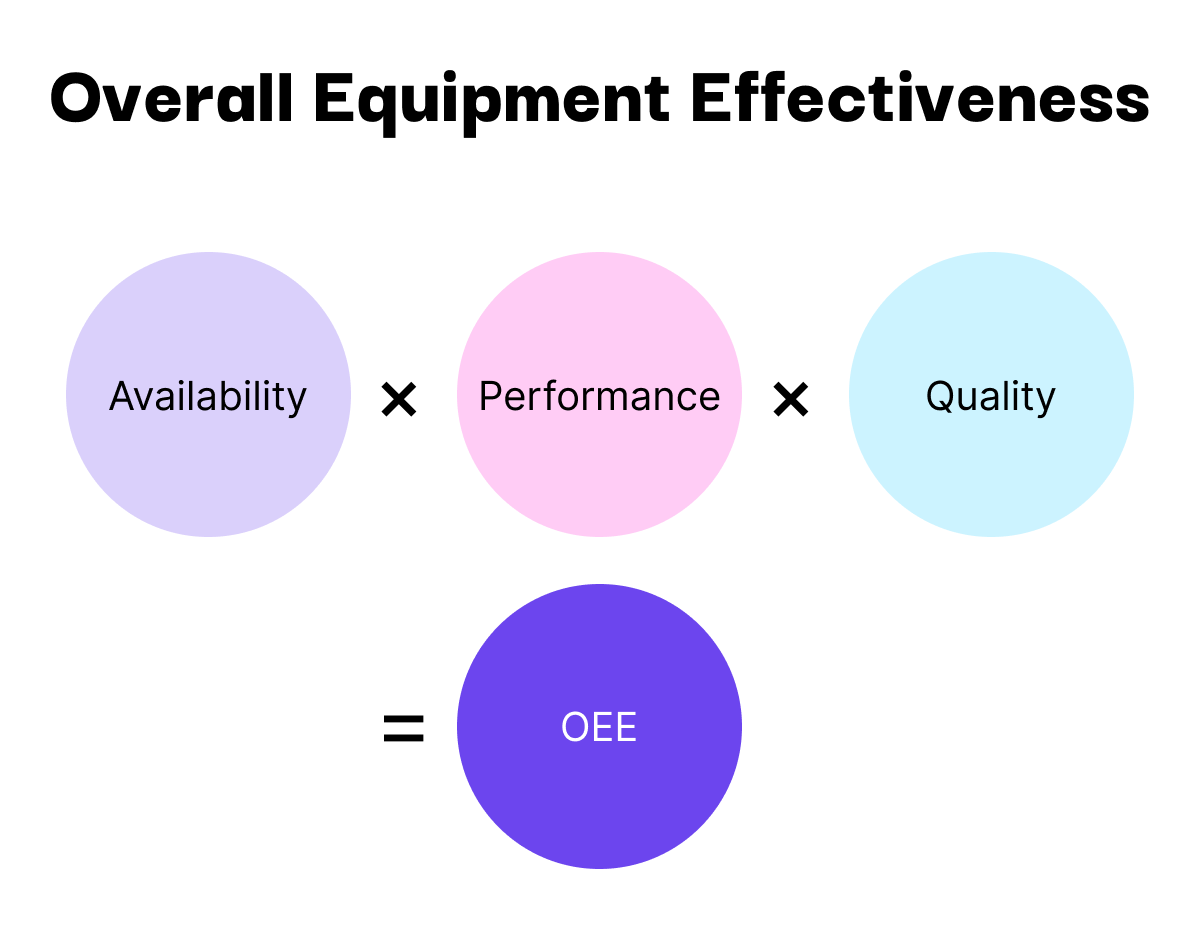
- Overall Equipment Effectiveness (OEE) is one of the most widely used manufacturing performance metrics. Rather than measuring only production output or downtime, OEE provides a complete view of production effectiveness by evaluating three key components:
- Availability – How much of the planned production time the equipment was available to run.
- Performance – How efficiently the equipment operated compared to its expected production speed.
- Quality – How many produced items met the required quality standards.
- These three measurements are combined into a single OEE percentage, making it easier to understand overall production efficiency while highlighting where losses occur. A theoretical OEE score of 100% means the process produces only good products, at the expected speed, with no downtime.
WHY IT MATTERS
- OEE provides a single, standardized measurement of manufacturing performance.
- Rather than simply showing how much was produced, it helps identify whether production losses are caused by:
- Equipment downtime.
- Reduced production speed.
- Product quality issues.
- By understanding which component is contributing most to lost productivity, improvement activities can be prioritized more effectively.
WHEN YOU WOULD USE THIS
Use this when:
- Measuring manufacturing performance.
- Monitoring production efficiency over time.
- Comparing production against performance targets.
- Identifying where productivity losses are occurring.
- Supporting continuous improvement initiatives.
HOW IT WORKS
- Factbird continuously collects production data and calculates OEE using the three core components: Availability, Performance, and Quality.
- OEE dashboards allow users to monitor overall effectiveness while drilling down into each component to understand what is reducing performance.
- Additional visualizations, including waterfall charts, show how different production losses contribute to the final OEE value:
- OEE1: Valued operating time/operating time
- OEE2: Valued operating time/production time
- OEE3: Valued operating time / manned time
- TCU (Total Capacity Utilization): Valued operating time / total equipment time
- OEE can be analysed across different reporting periods and filtered by production line, product, batch, or shift to compare performance under different operating conditions.
- OEE works alongside Stop Analytics, allowing users to investigate the recorded stop causes contributing to Availability losses and better understand production downtime.
KEY TERMS / COMPONENTS
Overall Equipment Effectiveness (OEE)
- A KPI that measures overall manufacturing effectiveness by combining Availability, Performance, and Quality.
Availability
- Measures how much planned production time the equipment was available to operate.
Performance
- Measures how efficiently equipment operated compared to its expected production speed.
Quality
- Measures the percentage of produced items that meet quality requirements.
Waterfall Chart
- A visualization that breaks down the different losses contributing to the final OEE score.
OEE Target
- A target value used to compare actual equipment effectiveness against expected performance.
COMMON MISUNDERSTANDINGS
- OEE is not simply a production count. It combines three separate measurements into one overall KPI.
- A high production volume does not necessarily mean a high OEE if downtime, reduced speed, or quality losses are significant.
- A perfect OEE score of 100% is a theoretical benchmark and represents producing only good products, at the expected speed, with no downtime.
- OEE identifies where productivity is being lost, but additional tools such as Stop Analytics help explain the underlying causes of those losses.